


Black Vultures Are Moving North: Farms Aren't the Only Properties at Risk
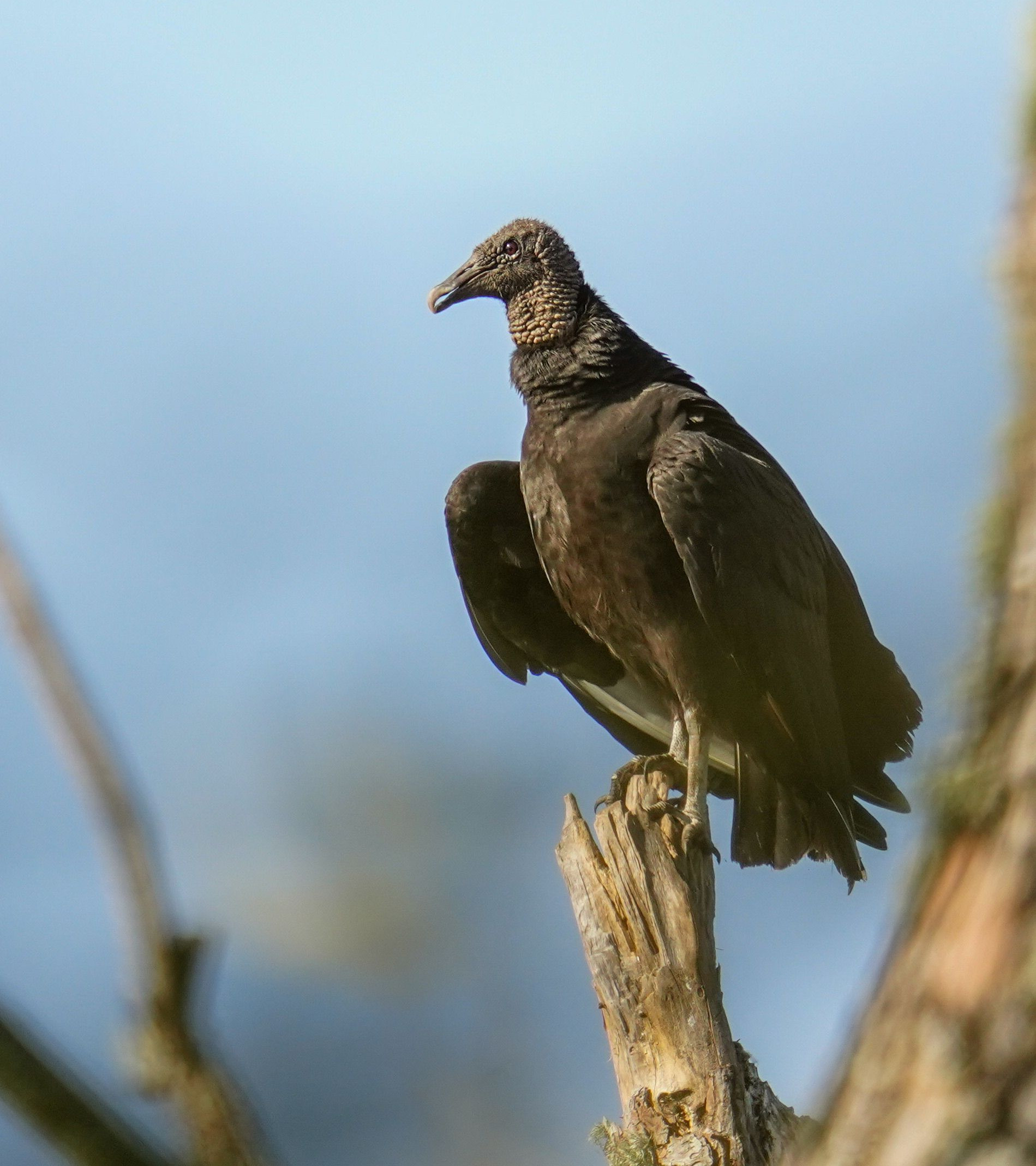
A recent Chicago Tribune feature followed a southern Illinois cattle farmer who lost a newborn calf to black vultures. A roughly $2,000 loss on a small operation with thin margins. Her response has since become something of a local legend: she and her fiancé hung a dead black vulture from a tree branch, in full view of the sky, hoping the sight would convince the rest of the flock to move on.
It's a folk remedy with real science behind it. But it's also a snapshot of how few options property owners feel they have when a species shows up that was never supposed to be there.
Because that's the real story. Black vultures aren't a southern problem anymore.
A Species That Keeps Pushing North
Black vultures have long been associated with the Southeast and the Gulf Coast. Over the past four decades (and sharply in the past twenty) their range has expanded up the Eastern Seaboard and westward into Indiana and Illinois. Researchers studying GPS-tracked birds point to a combination of warmer winters and a reliable food supply: roadkill, agricultural byproducts, and open farmland with places to perch.
Wildlife biologists studying the migration expect the trend to continue. Populations are increasing, and they're moving farther north.
For property owners in newly affected states, that means dealing with a bird most local contractors have never had to plan for. And black vultures are not pigeons. They're heavy, socially organized, persistent, and federally protected under the Migratory Bird Treaty Act.
Why Black Vultures Are Different From Turkey Vultures
Both species are now common across much of the eastern U.S., and from a distance they look similar. The differences matter.
Turkey vultures are strict scavengers with an extraordinary sense of smell. They find carrion and eat it. They're a nuisance when they roost in numbers, but they're not a threat to livestock.
Black vultures hunt by sight, travel in groups, and are considerably more aggressive. They'll follow turkey vultures to a food source, then displace them. They're also known to attack vulnerable live animals (newborn calves, lambs, and downed livestock). Field identification: black vultures have a gray, featherless head and white patches only at the very tips of the wings; turkey vultures have a red head and silvery flight feathers along the entire trailing edge of the wing.
Both species will roost communally on the same structures. That's where most property damage occurs, and where professional bird control does its most effective work.
The Damage Isn't Just Agricultural
Livestock predation gets the headlines, but vulture roosts create expensive problems on commercial and municipal properties, too:
Structural and equipment damage. Vultures are notorious for tearing rubber roofing membranes, window caulking, weather stripping, pool covers, and vehicle wiper blades. On rooftop HVAC units and communications equipment, this gets costly fast.
Droppings and uric acid. Large communal roosts produce heavy accumulations that corrode metal, stain masonry, and create slip hazards and sanitation concerns.
Operational disruption. Roosts on cell towers, water towers, silos, grain facilities, transfer stations, and warehouse rooflines interfere with maintenance access and worker safety.
Liability. Droppings on walkways, loading docks, and parking structures are a documented slip-and-fall exposure.
What Actually Works And What Doesn't
Here's the honest version, because it's the part most vendors skip.
Physical exclusion is the permanent fix, where you can install it. Netting, ledge modification, and structural exclusion don't rely on the bird being scared. They remove the option entirely. For barns, silos, food storage facilities, loading docks, warehouse rooflines, canopies, and covered equipment, heavy-duty bird netting with an appropriate mesh size is the highest-effectiveness solution available, with a 20+ year service life.
Deterrents work well on defined landing surfaces. For parapet walls, ledges, beams, signage, rooflines, and equipment platforms:
Electrified shock track conditions birds not to land after a few harmless corrections. Low-profile, low visual impact, good for properties with aesthetic constraints.
Grid wire systems cover wide-open flat areas (rooftops, solar arrays, docks) where birds want to gather in numbers. This is the workhorse for large-bird roosting problems.
Ledge modification (AviAngle) eliminates 90-degree ledges on I-beams, overpasses, parking structures, and towers.
Tension wire is a low-visibility option for railings, roof lines, and beams under moderate pressure.
A critical caveat on spikes: standard bird spikes are frequently the first thing property owners try, and for vultures they're often the wrong call. A bird that heavy can bend the rods and defeat the system. Species and weight class have to drive product selection. This is exactly where DIY attempts fail.
Scare-based methods have real but limited value. Effigies (a replica hung upside down with wings splayed, exactly what the Illinois farmer did) are endorsed by extension services and do work. So do lasers, pyrotechnics, and sound units for breaking up an established roost. The limitation is habituation: birds learn. These tools are best used to disperse a roost, then paired with exclusion or deterrent hardware so the birds have nowhere to come back to.
Roost removal and timing matter. Dispersal efforts are most effective when repeated near sunset over several consecutive evenings, and when dead trees and preferred perches are removed from the site.
One Thing No Contractor Can Sell You
Nobody can install hardware across seventy acres of open pasture. If the exposure is calving in an open field, the answer is management practice (birthing close to the barn and to human activity, prompt removal of afterbirth and carcasses, guardian animals, and effigies) supported by structural bird control on the buildings and roosts nearby.
The right approach is almost always a combination: disperse the roost, exclude the structures, and remove what attracted the birds in the first place.
Know the Law Before You Act
Black vultures are protected under the Migratory Bird Treaty Act. Lethal control requires a federal depredation permit through the U.S. Fish and Wildlife Service. In several states, livestock producers can obtain one through their state Farm Bureau, with strict limits on the number of birds. Acting without a permit carries real penalties.
Non-lethal exclusion and deterrent work requires no permit, which is one more reason to start there.
Get an Assessment Before the Roost Establishes
Vulture roosts are far easier and cheaper to address before a flock settles in for a season. If you're seeing groups of large black birds gathering on your towers, silos, rooflines, or water tanks (especially in a state where you've never seen them before), that's the moment to act.
AviAway has designed and installed bird control systems for over 20 years across commercial, agricultural, industrial, and municipal properties nationwide. Our certified specialists will identify the species, assess the roost, and design a system matched to the birds you actually have.
Schedule a free bird control consultation — call 844-247-3373 or request a quote online.
Comments